
The flagship · 1933–1955
The Conference
Hood put a basketball shoe on the market in Watertown in 1933 and spent the next twenty-two years taking things off it. By 1955 there was nothing left to take. This is the record: the catalogue pages, the teams that wore it, and the object itself.
The argument
A shoe that stopped changing.
Most objects we call classics were right once and then were left alone. The Conference is a different case, and a better one: it was published, sold, criticised by coaches and re-drawn, year after year, in a catalogue anyone could order from. You can watch it happen. The 1934 page describes ten features. The 1936 page describes eleven and adds a boast. By 1941 the upper is army duck and the sole has a name. By 1948 the whole shoe has been reduced to seven numbered lines, because there was nothing else worth saying about it.
Then it stops. The shoe Hood was selling in 1955 is the shoe it had been arriving at for two decades, and the company kept making it, essentially unaltered, until the plant closed. That is not neglect. That is a design running out of problems.
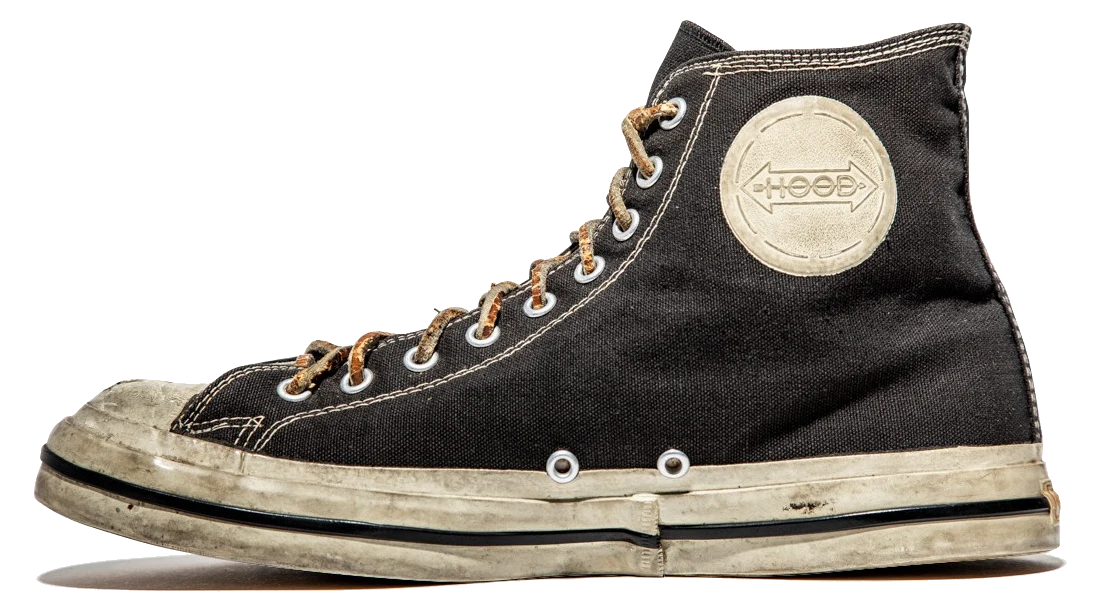
Black cotton duck. A cream rubber foxing carrying one black stripe. A plain moulded toe cap. A white rubber disc at the ankle with the Hood arrow driven straight through the name. Canvas and raw rubber went into the vulcanizer as separate materials and came out as one object — no glue line, nothing to delaminate. Take any part off and the shoe stops working. Nothing on it is there to be looked at.
Seventy years of copies have not improved on it. There was nothing left in it to solve.
Anatomy
Every part has a job.
The disc
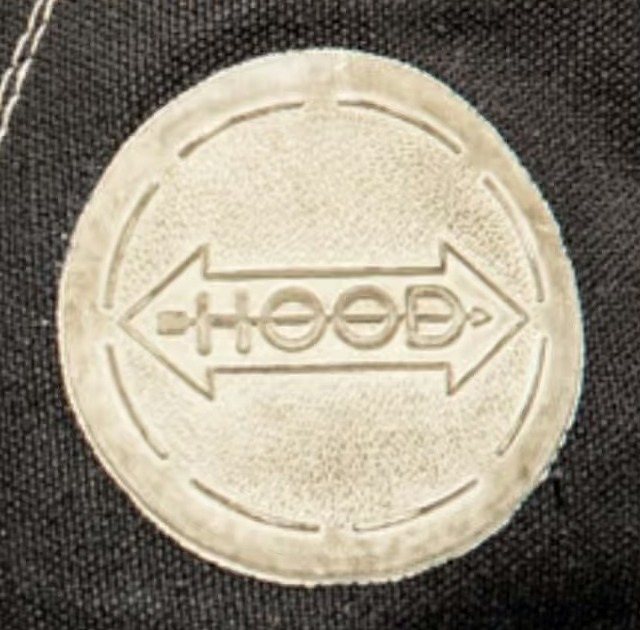
It is not a printed logo and it is not a stitched label. It is rubber, vulcanized into the canvas at the ankle, with the double-headed arrow — registered in 1907, pointing both ways by the nineteen-thirties — driven straight through the name. The mark is part of how the shoe is built. It signs the shoe and is built into it in the same operation, which is a thing almost no sneaker made since can say.
The toe cap
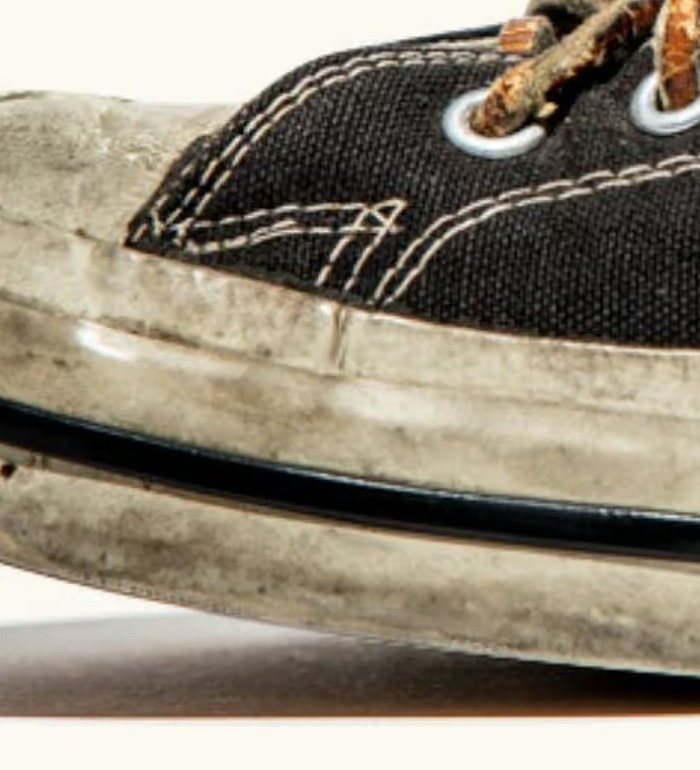
Armour at the one place a basketball shoe actually wears through — and the clearest thing the shoe gave up. The 1936 catalogue drawing shows the cap fluted, a row of vertical ribs across the front. By 1955 the ribs are gone and the cap is plain moulded rubber, stepped into the foxing. One less thing to make, and nothing lost.
The heel plate
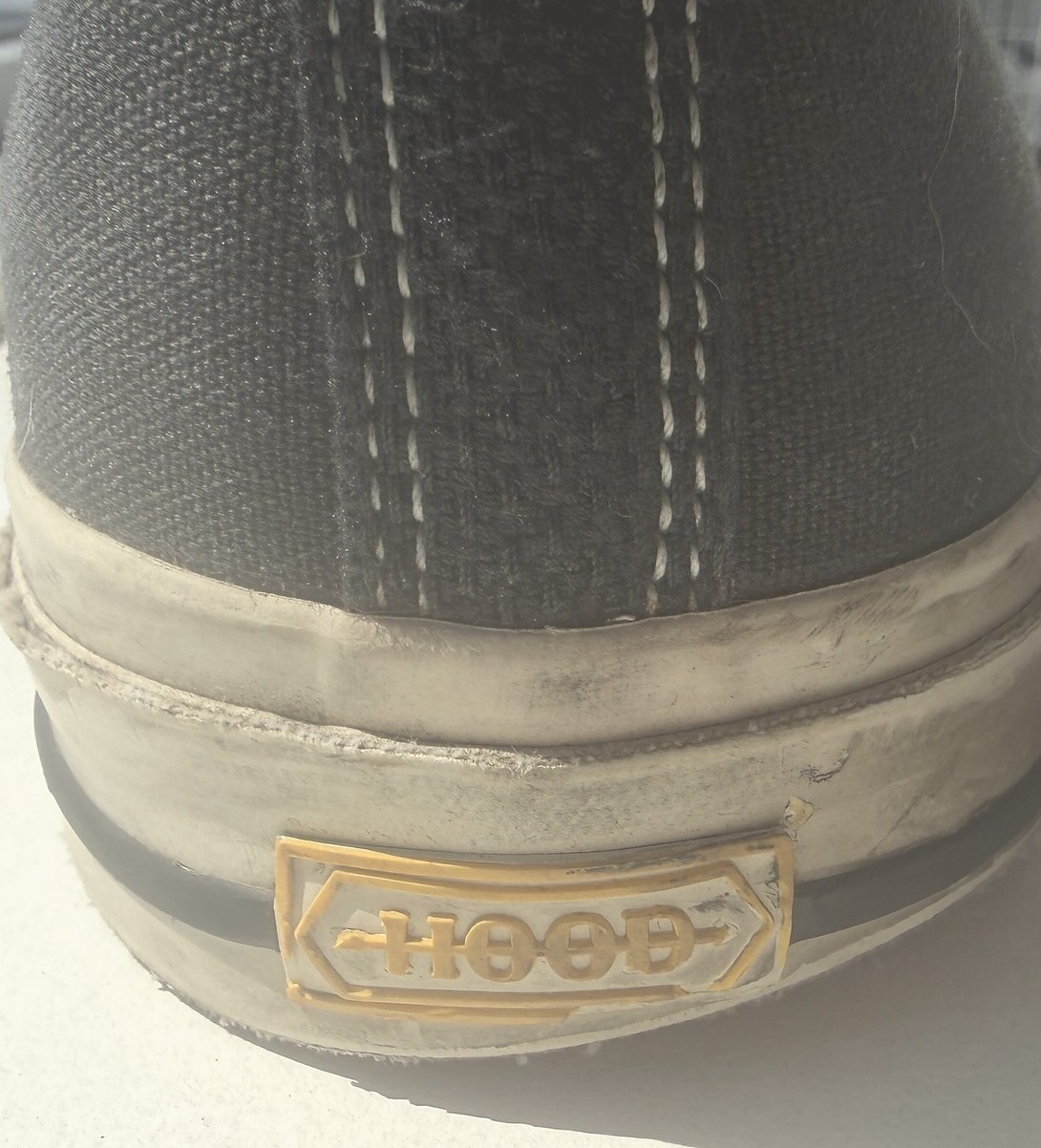
A second mark, about an inch across, moulded in amber rubber and set into the cream foxing at the back of the heel — the same arrow driven through the same four letters. It sits exactly where a number plate sits. The disc signs the ankle; this signs the heel.
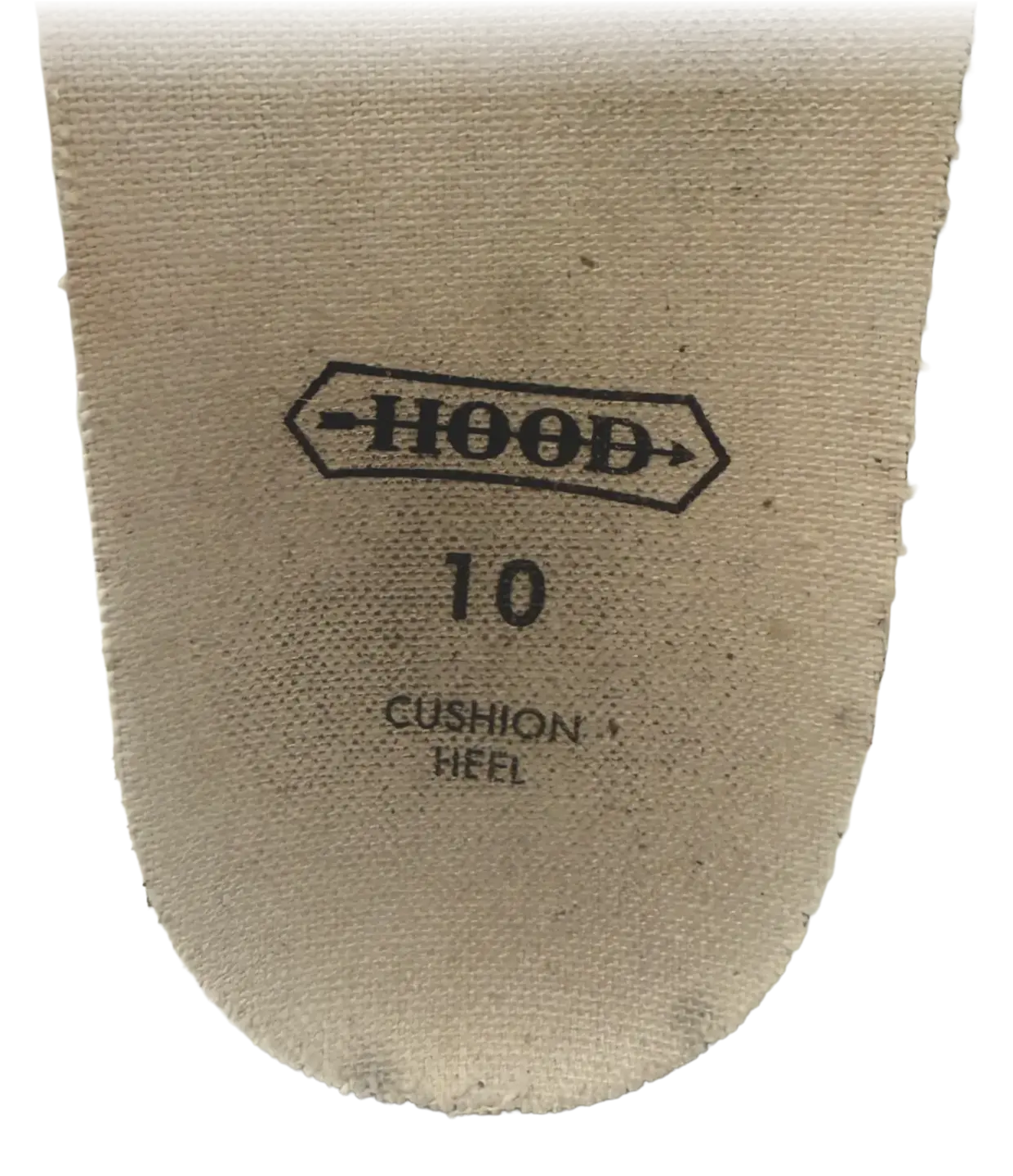
The insole
Lift the liner out and the shoe signs itself a third time — the arrow, the size, and two words that are not decoration. Cushion heel.
The sponge heel the 1934 catalogue page sold, printed on the one part of the shoe only the owner would ever see.
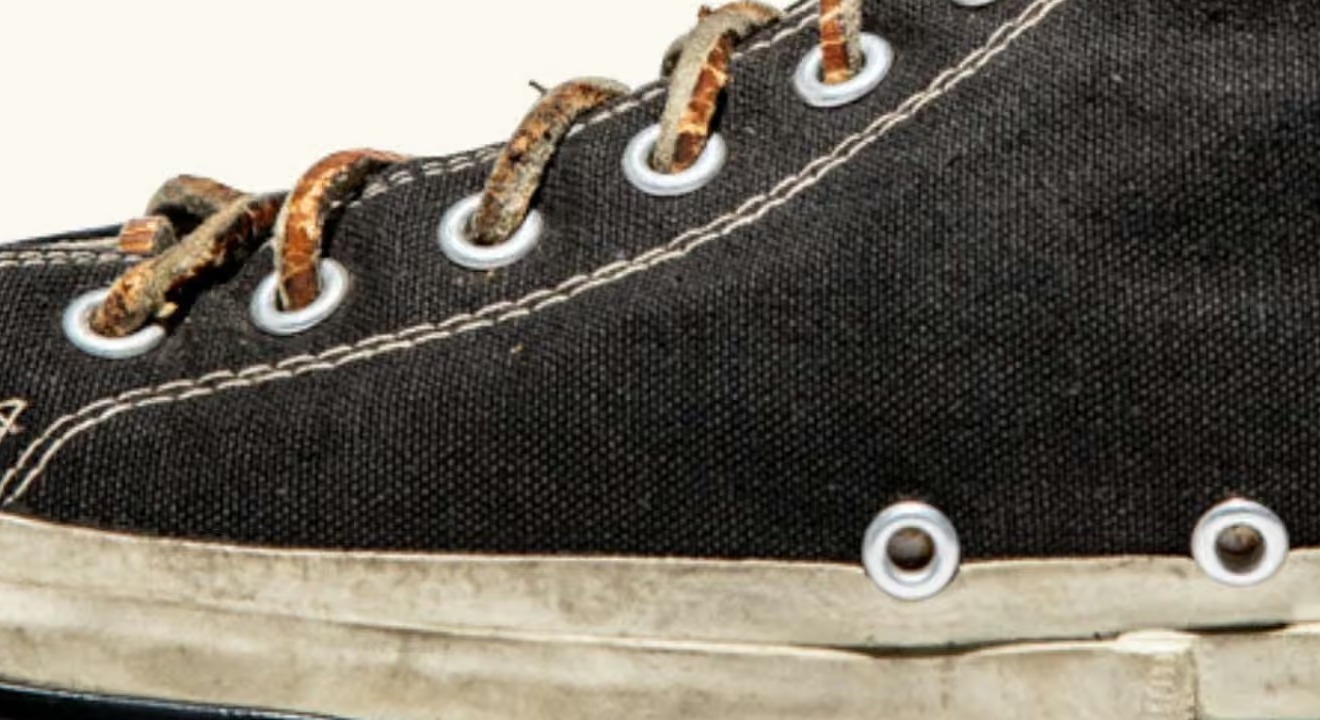
The eyelets
Telescopic eyelets set into the facing so they cannot pull out, with ventilating eyelets below the line.
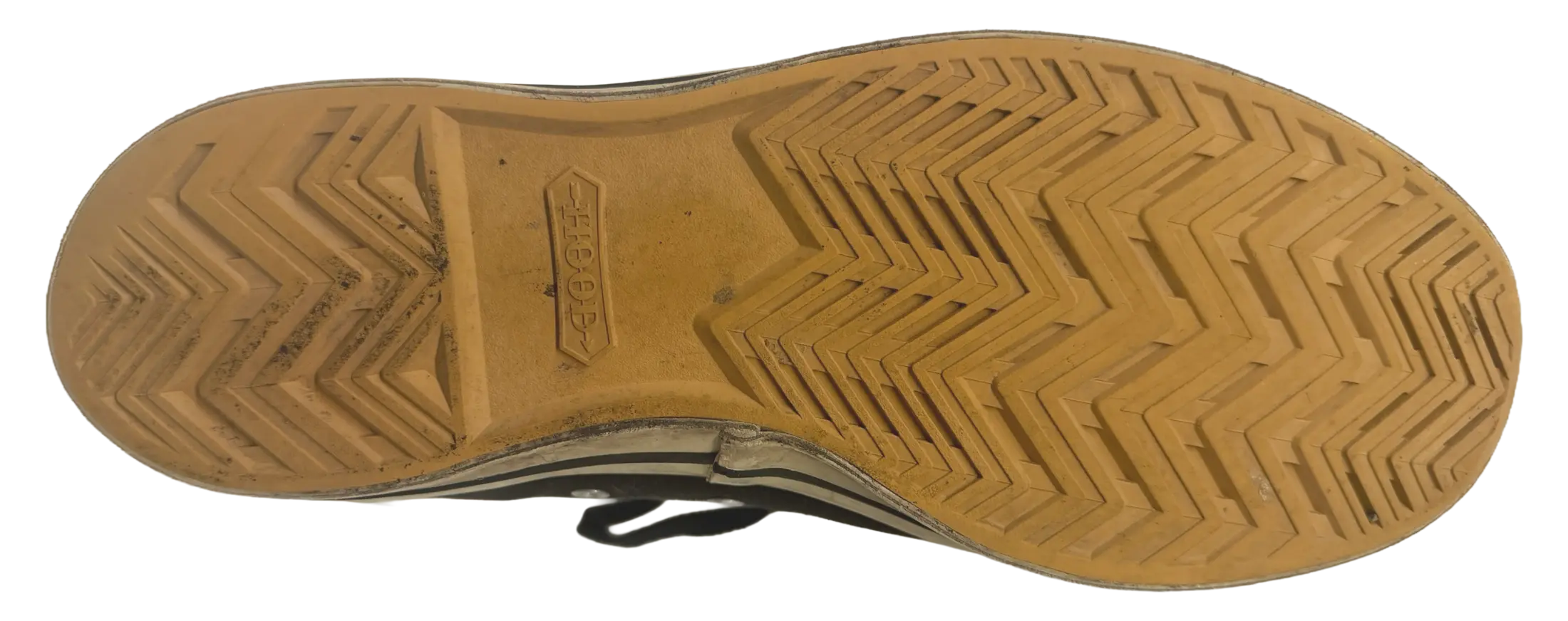
The outsole
Gum rubber, moulded in one piece, herringbone running the length of the tread — and the arrow stamped into the arch, the one stretch of the sole that never meets the floor. Every catalogue page from 1934 onward describes it in three words: moulded sole.
Seventy years of hardwood have not worn the stamp out.
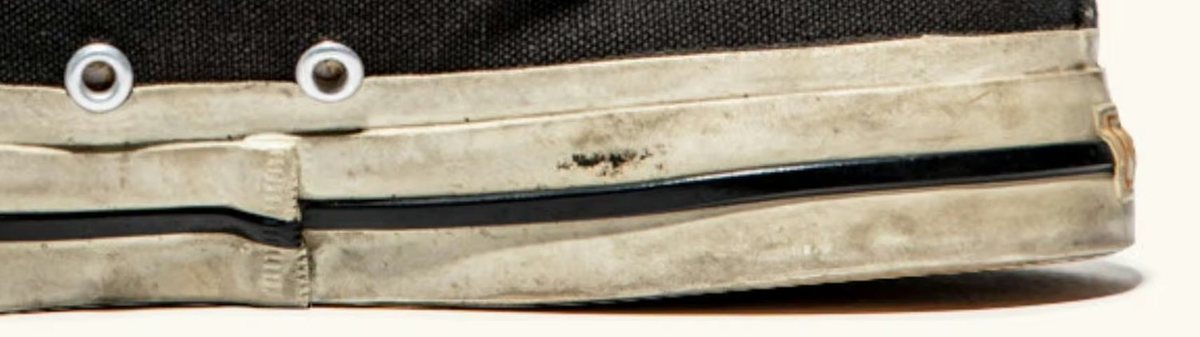
The foxing
A cream rubber band wrapping the join of upper and sole, carrying one black line. It is not trim. It is the seam.
Before it had a name · 1930–1932
Hood was already the basketball shoe.
The Conference did not arrive out of nowhere in 1934. Through the early thirties Hood was running national advertising for a whole basketball line — the Greyhound, the Centre, the Siak, the Clyde, the Forward, the Co-Ed — and claiming the results. These are the pages the Conference came out of. It is the argument in them, reduced to one shoe.
A player’s account of a game won on footwork, and two Hood shoes under it. The strapline runs along the foot of the page: Have more fun in Hoods.
Hood Rubber Company, Inc., Watertown, Mass., arguing its case in a numbered list under a photograph of a shot going up. Get more wear with Hoods.
Five models — Forward, Centre, Siak, Clyde, Co‑Ed — ringed by championship team photographs. Two years later Hood would put everything it had learned into one shoe and give it a name.
The lineage · four documents, twenty-one years
The same shoe, refining itself in public.
Every one of these is a page a coach could order from. Read them in sequence and the shoe argues itself down to essentials.
The first page to carry it. One paragraph of construction — loose lining, peg top, reinforced upper, moulded sole, sponge cushion heel, shaped padded tongue, telescopic eyelets, ventilating eyelets — and one promise: A long wearing shoe.
The paragraph becomes a list, and the copy starts naming the market: now being worn by many leading school and college teams everywhere.
Tufts, Detroit and Wisconsin under Coach Bud Foster among them.
Lace-to-toe bal. Heavy army duck upper, peg top specially reinforced against stretching, non-skid Rubalock moulded sole, felt padded tongue. Six upper colours against three trims. Stock 2750, men’s 6–13.
The end of the argument, and the shoe everything here was working towards. Collectors do not ask for the Gullwing; they ask for the ’54. This one is the ’55.
The line around it · 1936–1937
It was the top of a real range.
The Conference did not stand alone on the page. Hood sold a graded basketball line beneath it — the Phantom at a popular price, the Forward, the leather Prep and Speedshu, the Hoopster. Reading them together is how you see what the Conference actually was: not a marketing exercise, but the best-specified shoe in a working range, sold to coaches who were comparing line items.
Top of the page and second on it. The Phantom is described as a popular priced Hood basketball shoe
— the Conference needs no such qualifier.
Loose lining, peg top, cloth back stay, double side stays, white eyelets, a special design moulded outsole. The Conference’s specification, one grade down.
Heavy army duck, a tongue built so there is no ridge to chafe the toe, a buff outsole that will not mark a floor. Hood was still arguing about details in the year the Conference was already on championship teams.
On the floor
Who was actually wearing it.
Tufts College, Medford — The members of the Tufts College, Medford, Mass. basketball team are equipped with Hood Conference Shoes.
Hamtramck, Michigan, 1938 — The 1938 Detroit Metropolitan basketball champion was Hamtramck, Mich. High School. They wore Hood Conference shoes and were coached by Henry Collins.
Trinity University, San Antonio, 1948 — six players, twelve Conferences. Fourteen years after the name first appeared in a catalogue, it was still the shoe on the team photograph.
In the sporting-goods pages · 1947–1955
Side by side on the sale page.
Here is the part of the record the sneaker business has never had to answer for. Go to the newspapers — not the catalogues, not Hood’s own advertising, but the back-to-school columns where a store in Cincinnati or Amarillo or Richmond, Indiana had to tell a parent what to buy — and the Conference and the All Star are on the same line, at the same price, with Hood printed first.
Nobody was making a claim about heritage. They were selling shoes, and to the people selling them these two were the same thing.
Bolles Sporting Goods Co., back-to-school list. Basketball Shoes — Hood Conference…5.50. Converse All-Star…5.50.
Same line, same price, Hood first.
Henry Blackburn Sporting Goods. The two names run together in the headline — HOOD and CONVERSE
— and the shoe drawn underneath is wearing Hood’s disc at the ankle.
Brehm’s School Opening Sale. One entry covers both: Hood Conference and Converse All-Stars…$4.95.
Not two products — one line item.
J. C. Sporting Goods, bracketed two deep: Hood ‘All Conference’ / Converse ‘Chuck Taylor’ — 6.95.
Then Hood ‘Centre’ / Converse ‘Sport King’ — 4.95.
Model against model, price for price, in the year of the ’55.
Fourteen years later one of those two names was in a filing cabinet. It was not the shoes that decided it.
After the ’55 · 1956–1960
It did not stop in 1955.
The ’55 is the shoe this page is about, and the year is part of the name. But Hood did not put the Conference down that year. Bob Cousy’s Basketball Hints ran for four more seasons — 1956·57, 1957·58, 1958·59, 1959·60 — handed across shoe-store counters from Huntsville, Texas to New Castle, Pennsylvania. Partway through the run the name on the cover changes, from Hood Rubber Company to Hood Footwear Products. The shoe on the back cover does not.
Except, slightly, it does. The 1957–58 back cover lists eight features where the earlier printing listed seven, and the new one is a bumper toe-guard. And the ankle disc in the drawing has picked up a word: the surviving 1955 pair carries the arrow through H O O D and nothing else, while by 1957 the model name is curved around the bottom of the ring. Twenty-four years in, they were still moving things.
The page the booklets had closed with for years. In this printing the feature list beneath it has grown from seven items to eight, and the new one is a bumper toe-guard — the pale band wrapped around the toe here. Above the outsole, the herringbone tread Hood had been putting under the shoe since the thirties.
Given away by Rogers Shoe Store, Huntsville, Texas. Cousy is on the cover as he is on every edition; through these years he was Hood’s athletic staff director.
In the artwork the model name has joined the mark. On the surviving 1955 pair the disc is the arrow and the four letters alone — compare it with the photograph higher up this page.
The return
Same pattern. Same disc.
The Conference returns
Be here when it does.
There is no date yet. Leave an address and we will write to you once — when there is something real to see.